


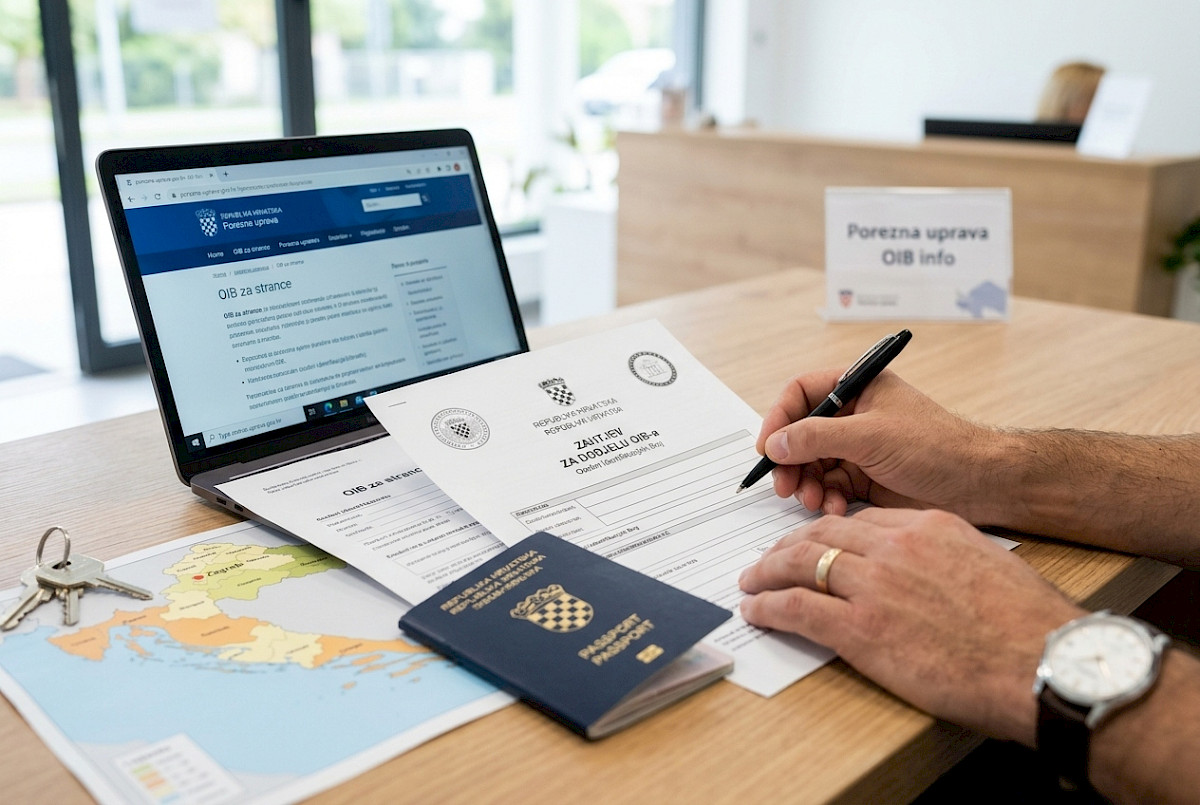
For years, the Republic of Croatia has attracted numerous foreign nationals—whether they are investors looking to purchase property on the coast, digital nomads, foreign workers, or entrepreneurs starting a business. Regardless of the reason for your arrival or the intended duration of your stay, one of the first administrative steps you will encounter is obtaining a Personal Identification Number, known by the Croatian acronym "OIB."
If you are a foreign national wondering what an OIB actually is, who is required to have one, what the conditions are, and what the assignment process entails, this guide provides a comprehensive overview of Croatian administrative practice.
What is an OIB, and why do foreigners need one?
The Personal Identification Number (OIB) is a permanent identification marker assigned to every individual, used by public authorities in the Republic of Croatia for official records. It is a unique 11-digit number, consisting of ten digits generated randomly and one check digit calculated according to an international standard.
It is important to note that an OIB is non-revealing, immutable, and unique. This means it does not disclose personal information such as date of birth or gender; once assigned, the number remains linked to an individual for their entire lifetime (and is not reassigned after death).
Foreign nationals are required to obtain an OIB whenever a so-called "basis for tracking" arises in Croatia. This primarily applies to:
• The purchase or sale of real estate in Croatia.
• Opening an account at a Croatian bank. • Starting your own company or sole proprietorship (trade business).
• Entering into an employment relationship.
• Submitting an application for temporary or permanent residence through the Ministry of the Interior (MUP).
• Paying taxes and participating in other legal and financial processes.
Without an OIB (Personal Identification Number), it is impossible to register ownership of real estate in the land registry, nor can you carry out almost any significant legal transaction in the country.
When and how do you apply for an OIB?
The procedure for obtaining an OIB for foreign nationals depends on whether you are coming from a European Union (EU/EEA) member state or from a so-called "third country," as well as whether you have already registered your residence.
1. Automatic assignment via the Ministry of the Interior (MUP) (Residence registration)
If you are coming to Croatia with the intention of obtaining temporary or permanent residence, the process is significantly simplified. When you submit your residence application to the competent police administration or police station (MUP), the Ministry of the Interior automatically forwards your data electronically to the Tax Administration for the purpose of assigning an OIB. In this case, foreign nationals do not need to go through a separate procedure at the Tax Administration offices, as the OIB is issued as an integral part of the residence approval process.
2. Independent Application (Non-residents and Real Estate Buyers)
If you are not required to regulate your residency status, but are purchasing real estate in Croatia, establishing a company, or require an OIB (Personal Identification Number) for other legal reasons, you must initiate the process yourself or through an authorized representative.
The application may be submitted:
• In person at the competent Tax Administration office: The application is submitted at the office corresponding to the location where the need for the OIB arises (e.g., the location of the real estate you are purchasing). If all documentation is in order, the OIB can often be obtained very quickly—sometimes even on the same day.
• Online (via e-Porezna / the e-Citizens system): EU/EEA citizens may submit an application online through the Tax Administration’s system, provided they possess the appropriate digital credentials and certificates.
• Via diplomatic missions and consulates: The application may also be submitted at Croatian embassies or consulates abroad; however, this procedure via diplomatic channels typically takes longer (several weeks).
Documentation Required to Obtain an OIB
To ensure the process goes smoothly and without unnecessary delays, please prepare the following documentation:
1. A completed Application for the Determination and Assignment of an OIB: The official form can be downloaded from the Tax Administration’s website and is available in several foreign languages (including English and German).
2. A valid identification document: You must present your original passport and provide a copy. EU/EEA citizens may submit a valid European national identity card instead of a passport.
3. Proof of the reason for requesting an OIB (if applicable): Depending on the circumstances, this may include a pre-contract or a real estate purchase agreement, documentation regarding the establishment of a company, or other evidence of a tax liability.
4. Power of attorney (optional): If you are unable to visit the Tax Administration in person, you may authorize a representative. The power of attorney must be valid and either drawn up in the Croatian language or translated by an authorized court interpreter.
When it comes to specific investments—such as purchasing real estate along the Adriatic coast or in the country's interior—the entire process can prove challenging for foreign buyers unfamiliar with the local administrative landscape. For this reason, many investors choose to work with trusted agencies. For instance, the expert team at RESIDENT Nekretnine is available to assist clients by streamlining the buying and selling process, guiding them through administrative steps, and ensuring that acquiring property in Croatia is a completely secure and straightforward experience.
Specifics for EU Citizens and Nationals of Third Countries
The process varies somewhat depending on your citizenship:
• EU/EEA Citizens: Benefit from a significantly simplified process, as they enjoy the freedom of movement and the right of establishment. They can utilize digital services, and their national identity card is generally sufficient for identification purposes when accessing these systems.
• Nationals of Third Countries (outside the EU/EEA): Must consider additional requirements, such as verifying the principle of reciprocity regarding real estate acquisitions. If no such reciprocity exists between Croatia and the individual's home country, they may need to establish a business entity (such as a limited liability company, or *d.o.o.*) in Croatia to carry out the purchase. In such cases, an OIB (personal identification number) must first be obtained for the legal entity (the company) itself.
Obtaining and Keeping Your OIB Certificate
Once the Tax Administration has processed your application and verified the accuracy of the information, they will issue an official Certificate of Assigned Personal Identification Number (OIB).
This certificate does not have an expiration date and carries the legal weight of an official public document. It is important to keep it safe, as you will need to present it whenever you register assets or other records, open a bank account, or enter into a contract.
Conclusion
Although bureaucratic procedures in a foreign country may initially seem complex or daunting, obtaining an OIB (Personal Identification Number) for foreigners in Croatia is actually a standardized and straightforward process once you have prepared all the necessary documentation. Whether you are coming to Croatia for leisure, real estate investment, or business expansion, the OIB is a key document that opens the door to the Croatian legal, financial, and administrative systems. With timely preparation and professional support, you can complete the entire process quickly and without stress.